Historic brick and stone rowhomes throughout Philadelphia County present shared structural vulnerabilities that standard chemical treatments cannot resolve. In dense neighborhoods like South Philadelphia, Fishtown, and…
Historic brick and stone rowhomes throughout Philadelphia County present shared structural vulnerabilities that standard chemical treatments cannot resolve. In dense neighborhoods like South Philadelphia, Fishtown, and Queen Village, attached residences share continuous brick party walls, common joist pockets, and interconnected utility lines. When a single property harbors an active rodent population, standard broadcast baits or snap traps merely create a temporary lull while satellite colonies navigate behind shared plaster and lathe. Field observations show that a juvenile house mouse requires an opening of only 0.25 inches (6 millimeters) to migrate between connected dwellings, rendering perimeter-only chemical sprays functionally useless against inter-wall transit.
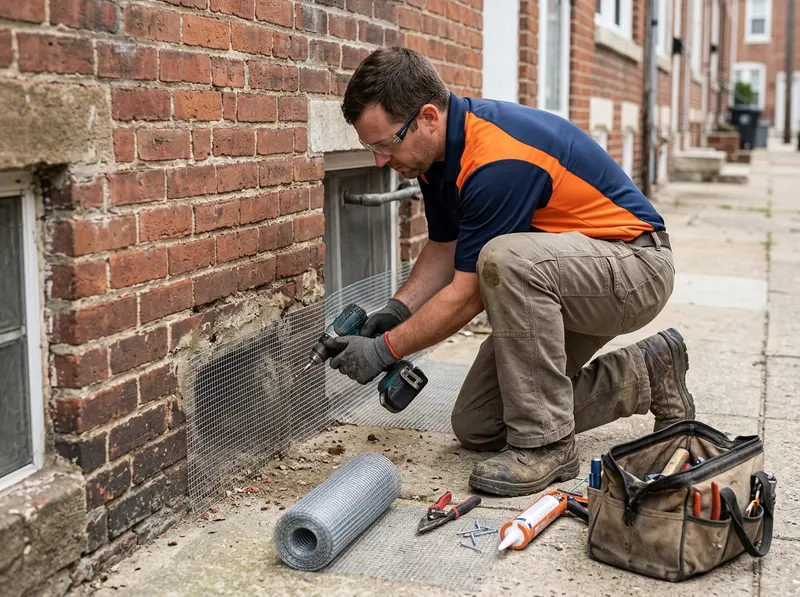
Effective rodent defense requires targeted physical modification of the building envelope. In older housing stock across Manayunk, Northern Liberties, and Port Richmond, field teams focus directly on rubble stone foundations, deteriorated lime mortar joints, and unsealed radiator pipe penetrations. Technicians seal subterranean voids using 19-gauge galvanized hardware cloth paired with non-corrosive copper mesh and industrial hydraulic sealants that rodents cannot chew through. In historic areas such as Chestnut Hill and Mount Airy, larger single-family and semi-detached properties often require attic soffit repairs and chimney flashing updates to prevent roof-level rodent access along adjacent tree branches.
The process follows three systematic phases: baseline identification, mechanical installation, and indoor trapping clearance. First, technicians map every foundation crack, crawlspace opening, and pipe chase between the basement floor and the roofline. Second, entry pathways receive permanent metal and concrete blockades without damaging historic masonry facades. Third, interior snap-trap arrays placed inside crawlspaces and mechanical rooms eliminate any rodents stranded inside the newly enclosed envelope. This structural exclusion approach avoids toxic bait blocks that cause target rodents to perish within inaccessible wall voids, eliminating the secondary decomposition odors that disrupt rowhome living spaces.
Every job gets a firm, written price after a free on-site visit.
Tell us about your rowhouse rodent exclusion job in Philadelphia and we'll send a clear, written quote, usually the same day.
 Kelvoro Pest Solutions