Urban mosquito pressure in Philadelphia County centers on two dominant vectors: the common house mosquito (Culex pipiens) and the invasive Asian tiger mosquito (Aedes albopictus). In densely built neighborhoods such as…
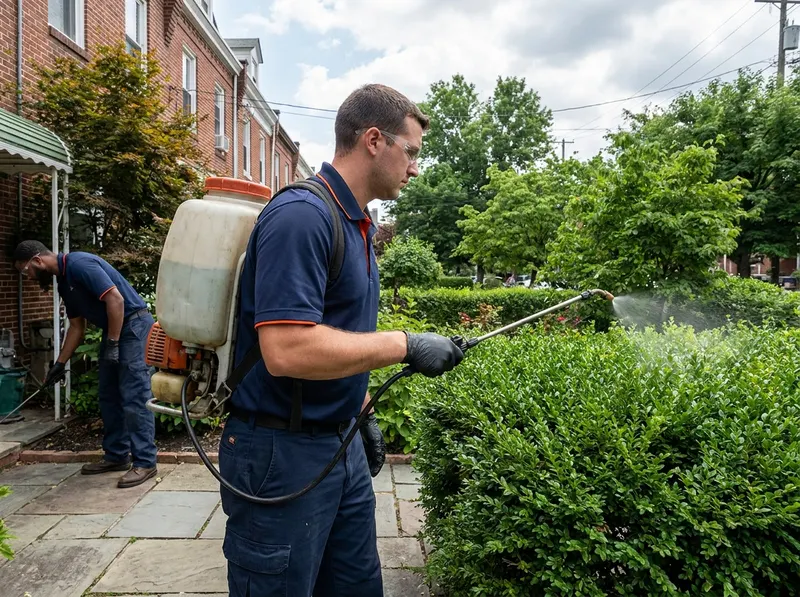
Urban mosquito pressure in Philadelphia County centers on two dominant vectors: the common house mosquito (Culex pipiens) and the invasive Asian tiger mosquito (Aedes albopictus). In densely built neighborhoods such as South Philadelphia, Fishtown, and Queen Village, historic brick rowhomes feature shared masonry property lines, narrow 4-foot alley breezeways, and sunken concrete patios. These confined corridors trap daytime humidity and collect shallow standing water in uncleaned gutter downspouts, corrugated drain pipes, and saucer plates under potted plants. Aedes albopictus bites aggressively during daylight hours and requires as little as one tablespoon of stagnant water to produce up to 200 eggs within a 7-day cycle. Standard perimeter treatments fail when operators treat only exterior turf while ignoring the vertical microclimates where vectors harbor between blood meals.
Seasonal mosquito barrier application delivers targeted treatment to the undersides of broadleaf plants, English ivy groundcovers, boxwoods, wooden fence paneling, and shaded brick undersills. In larger properties across Chestnut Hill, Mount Airy, and Manayunk that border Wissahickon Valley Park and Fairmount Park, dense canopy cover and drainage swales create expanded harborage requiring backpack mist blowers calibrated to 50-to-100-micron droplets. These micro-droplets adhere to vegetative resting canopies without causing runoff into municipal storm systems or native pollinator beds. For properties in Northern Liberties and University City with tight patio footprints, handheld compression sprayers provide directional control around stone masonry, dining zones, and structural foundations, avoiding non-target exposure.
Decision guidance depends on property size and proximity to standing water sources. For single-family rowhouses with rear courtyards under 1,000 square feet, monthly barrier treatments combined with source-reduction larvicide dunks in rain barrels provide effective reduction throughout the active May-to-October season. For detached properties exceeding 0.25 acres with natural tree lines, treatments must extend 20 to 30 feet into peripheral wooded margins to intercept incoming vector swarms from public parkland. The trade-off between synthetic micro-encapsulated pyrethroids and natural botanical barriers centers on longevity: synthetic residual barriers maintain efficacy for 21 to 28 days through rain events, whereas botanical garlic or cedarwood solutions require re-application every 14 days due to accelerated photodecomposition under direct summer sunlight.
Every job gets a firm, written price after a free on-site visit.
Tell us about your seasonal mosquito barrier application job in Philadelphia and we'll send a clear, written quote, usually the same day.
 Kelvoro Pest Solutions